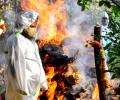
Terming coronavirus as a big health crisis before humanity, Madhya Pradesh Chief Minister Shivraj Singh Chouhan on Thursday said the only way to break the chain of transmission and contain COVID-19 cases is for people to 'close down everything' till May 15.

'The Indian economy has been subsidised by the poor.'
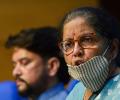
Later, there may be some tax relief aimed at the middle class and measures to benefit the sectors worst hit by Covid-19 and the resultant nationwide lockdown.

The party's research department team, which Rajya Sabha member M V Rajeev Gowda heads, has sifted through the suggestions received in the last five months, and the manifesto is slated to be released later this month, reports Archis Mohan.

India's rural employment guarantee programme MNREGA has been ranked as the world's largest public works programme, providing social security net to almost 15 per cent of the country's population, the World Bank has said.

'Elections are fought to win.' 'In our party, the leadership takes the final decision, and our leaders are very clear about it.'

'Farmers love cows but find it uneconomical to afford fodder expenses'

'UBI is a tricky subject.' 'Our worry is the government could get rid of UPA's social welfare schemes targeted at the poor.'

This will, of course, go a long way in meeting the promised fiscal deficit target of 3.6 per cent of GDP in 2015-16.

Leader of Opposition in Kerala Assembly Ramesh Chennithala demanded a judicial probe into the circumstances that led to opening of shutters of 40-odd dams at a time in the state.

EPFO has verified or attested 64.67 lakh Aadhaar numbers.
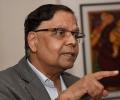
It raises three major questions - the incentive compatibility issue, the fairness issue and fiscal challenge, said Panagariya.
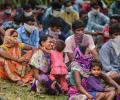
He also rejected reports that have hinted possible increase in coronavirus cases due to migrants and asked, "Did corona not spread at places where migrants were not there?"

Maharashtra has the opportunity to solve all these problems by voting for the Congress and NCP, he said.

The government will announce minimum support prices for kharif.

Of the cash outgo, Rs 64,598 crore is for enhanced expenditure on fertiliser subsidy under Atmanirbhar Bharat Abhiyan 3.0 and Rs 20,466 crore for the capital outlay in defence services.
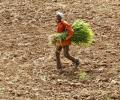
In spite of Budget's rural focus, the government has consistently stumbled in agriculture, says Shreekant Sambrani.

Market linking of petrol and diesel prices has helped the industry.

The praise comes a year after Prime Minister Narendra Modi termed it a 'monument of UPA's failures'.

Congress vice president says people now laugh at Modi's promise of 'achche din'.

A look at the key decisions taken by the Narendra Modi government in its six months.

Ekka, who is embroiled in the controversy for allegedly signing official documents at a private place, was removed from the post following Bharatiya Janata Party's allegation of his conniving with middlemen.
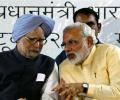
NDA under Mr Modi is as focused on the rural poor with doles and hand-outs as the UPA under Dr Singh was.

The strike notices were given by workers' unions of various sectors such as coal, steel, oil, telecom, postal, income tax, copper, banks and insurance.

Rural outlay may go up 23% to reduce pains of demonetisation
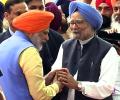
Whether it was the MGNREGS or the NFSA or the Aadhaar-based DBT scheme for cash transfer, the Modi government has built on the basic architecture created by the Singh government. Policy makers in the Modi government, instead of discarding them as products of the previous political regime, worked on them, expanded their scope and reach, and used new tools to improve their performance, explains A K Bhattacharya.

To make possible discretionary spending including capex and that on welfare, the government decided to borrow more than planned in FY21 -- Rs 12.7 trillion.
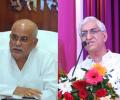
Singh Deo will, however, remain the minister for Health and Family Welfare, Medical Education, Twenty Point Implementation and Commercial Tax departments.

Jharkhand mining secretary Pooja Singhal, earlier arrested and remanded to the custody of the ED in a suspected money laundering case, was suspended by the Jharkhand government on Thursday, an official said.

Prime Minister Narendra Modi's idea of cooperative federalism is expected to be on display in the 2015-16 Budget.
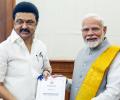
With its age-old fascination for education, southern states have done better than the North. Start-ups, IT hubs, and industry majors setting up shop have changed the face of the South. Nearly 79% of global offices set up by international conglomerates in India are in the South. Almost 46% of tech unicorns are from the South. The GDP per person in the South is 4.2 times higher than the North. None of these indicators can be ignored by any central government, whatever the political compulsions, notes Ramesh Menon.
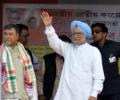
Hitting the campaign trail in Assam for the first time this election, Prime Minister Dr Manmohan Singh on Saturday lambasted the Bharatiya Janata Party as a "party that divides the people and thinks through only one person."

Could it have been more reformist? Of course, but this is an election year Budget, observes Akash Prakash.

The Odisha government told the assembly over 40,000 workers migrated from the state last year, with the highest number -- 26,151 -- from Balangir.
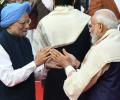
False and acrimonious debates such as Modi versus Manmohan might allow for victories that are political and partisan. But the real loser is the nation, India and Bharat, notes Arvind Subramanian, former chief economic advisor to the Modi government in its first term.
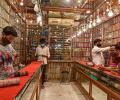
'Usually, urban wage rates are 50 per cent higher than rural wage rates. But, this could be narrowing very rapidly now,' points out Mahesh Vyas, CEO, Centre for Monitoring Indian Economy.

A good agricultural harvest and a timely arrival of monsoon, besides a slew of government schemes, have also come as a bounty.

The government last fiscal missed its direct tax collection target, and for this financial year it has set a higher revenue mobilisation goal of Rs 13.80 lakh crore.

'The government does not want to be transparent or accountable. Therefore, they do not want to appoint information commissioners.'
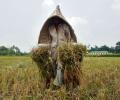
The focus is likely to be on consolidation and improvement of existing rural-centric programmes to ensure their completion ahead of the next general elections in 2019, rather than announcement of new schemes. Sanjeeb Mukherjee and Arup Roychoudhury report.
